
Providing an accurate Estimated Time of Arrival (ETA) to the port agent and pilot station is one of the deck officer's most frequent tasks. In a vacuum, ETA is a simple formula: Distance divided by Speed. However, the ocean is not a vacuum.
The Triangle of Velocities
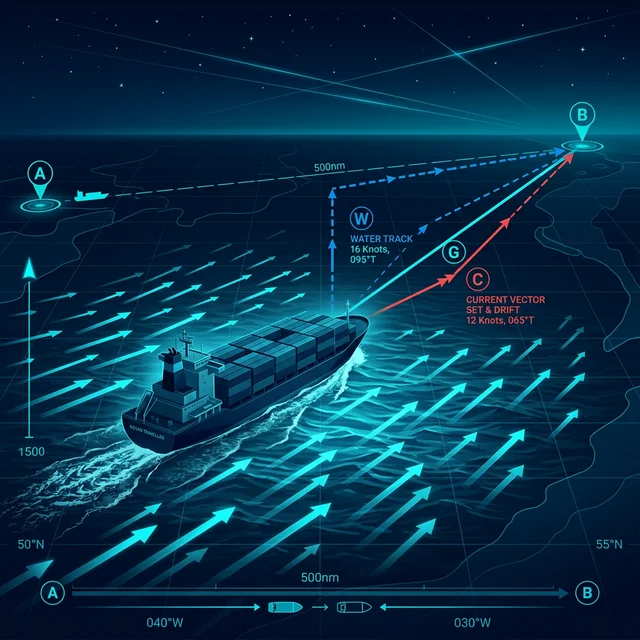
To accurately calculate how long a voyage will take, you must understand the difference between Headings and Courses, and Speeds and Velocities. This is modeled using the Triangle of Velocities.
The three sides of the triangle are:
- Water Track: The direction the ship's bow is pointing (Heading) and the speed the engine is pushing through the water (Speed Through Water - STW).
- Current (Set and Drift): The direction the ocean current is traveling toward (Set) and the speed of that current (Drift).
- Ground Track: The actual path the ship is traveling over the earth (Course Over Ground - COG) and the speed it is traveling over the ocean floor (Speed Over Ground - SOG).
Correcting the Basic Engine Speed
If you only divide the distance to your waypoint by your engine speed (STW), your ETA will be wrong the moment you hit a tidal stream. If the tide is pushing against you, your SOG drops, and your ETA will be delayed.
Vector addition combines the Water Track vector with the Current vector to result in the Ground Track vector.
Example: Cross Currents
What if the current isn't directly ahead or behind, but pushing from the side? This is known as a cross-current. A cross-current will push the vessel off its intended rhumb line course.
If you maintain your intended heading, the current will "set" you to the side. To maintain the intended course line (the line drawn on your chart), you must alter your heading into the current. Because some of your engine's power is now being used to fight the sideways push of the current, your forward progress (SOG) along the course line will be reduced, which ultimately delays your ETA.
The Rhumb Line vs Great Circle Impact
For short distances, rhumb line calculations (steampath fixed headings) are sufficient. For transatlantic or transpacific voyages, Great Circle tracks must be used to find the shortest distance over the curvature of the earth. Calculating ETAs for a Great Circle route involves dynamically changing headings and varying weather/current patterns across ocean systems.
Sources and verification
Use these references as the starting point for verification; always follow current flag-state, company, port, and approved shipboard documents for operational decisions.
Calculations Without the Headache
CaptainCalc provides a dedicated Quick Calcs suite on the bridge. Simply input your current GPS position, your waypoint, and anticipated Set & Drift. The app solves the vector triangle, outputs the required true heading to maintain your course line, and calculates the exact ETA instantly.