
What Does STCW Stand For? Training, Certification and Watchkeeping
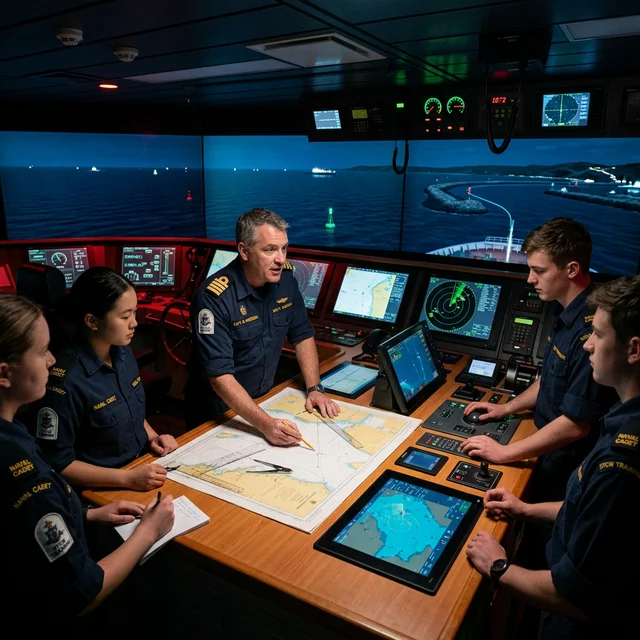
STCW sets the minimum training, certification, rest-hour and watchkeeping rules that decide whether a seafarer is competent to stand a safe watch. This guide explains what STCW requires, what changed under the Manila Amendments, and why masters and deck officers should treat certificate control as part of voyage risk management.
Quick answer: what does STCW stand for?
STCW stands for Standards of Training, Certification and Watchkeeping for Seafarers. It is the IMO framework that sets minimum competence, certificate and watchkeeping standards for people working on seagoing ships.
- Basic Safety Training is the entry-level safety package for many seafarers.
- Certificates and endorsements normally need periodic revalidation.
- Masters and officers should connect STCW compliance with fatigue control, watchkeeping and Port State Control readiness.
For day-to-day bridge work, STCW is not an abstract certificate file. It affects watch schedules, fatigue control, ECDIS competence, emergency response and Port State Control readiness.
The International Convention on Standards of Training, Certification and Watchkeeping for Seafarers (STCW), established by the International Maritime Organization (IMO), changed all of that. Today, it stands as one of the most crucial pillars of maritime safety, alongside SOLAS, MARPOL, and the MLC.
What is the STCW Convention?
The STCW Convention prescribes minimum standards relating to training, certification, and watchkeeping for seafarers which countries are obliged to meet or exceed. The fundamental concept is that a ship is only as safe as the crew operating it. No matter how technologically advanced a vessel is, human error remains the leading cause of maritime incidents. STCW aims to mitigate this by ensuring a globally standardized level of competence.
The 1995 and 2010 (Manila) Amendments
The original 1978 convention was completely revised in 1995 to clarify the standards of competence required, and it established the STCW Code. The Code is divided into two parts: Part A is mandatory, and Part B contains recommended guidance.
The more recent Manila Amendments (2010) brought significant updates to keep the convention relevant in the modern era. Key additions included:
- New rest hour requirements to prevent fatigue.
- New certification requirements for able seafarers.
- Mandatory security training relating to piracy and armed robbery (aligning with the ISPS code).
- Training in modern technology (e.g., ECDIS).
- Requirements for medical fitness standards.
Basic Safety Training (BST)
Anyone working on a commercial seagoing vessel must complete STCW Basic Safety Training. This forms the absolute foundation of survival and emergency response at sea. It comprises four modules:
- Personal Survival Techniques (PST): Learning how to survive at sea in the event of ship abandonment, including donning lifejackets, jumping safely into the water, and boarding liferafts.
- Fire Prevention and Fire Fighting (FPFF): Practical training in using firefighting equipment like extinguishers, hoses, and breathing apparatus (SCBA) in smoke-filled, simulated environments.
- Elementary First Aid (EFA): Immediate action to take upon encountering an accident or medical emergency on board.
- Personal Safety and Social Responsibilities (PSSR): Safe working practices, understanding shipboard hazards, and pollution prevention.
Continuous Competence
A key aspect of STCW is that training is not a one-time event. Seafarers must provide evidence of having maintained the required standard of competence every five years. This often involves taking refresher courses, particularly for survival and firefighting modules, to ensure skills remain sharp.
Conclusion
The STCW Convention ensures that whether a vessel is sailing out of Rotterdam or Singapore, and whether the crew is from the Philippines or Greece, everyone shares a common foundation of safety and operational expertise. It is a demanding standard, but it is one that has undoubtedly saved countless lives at sea.
Keep bridge checks available offline
CaptainCalc gives deck officers offline voyage, celestial, stability and reference tools for the practical work that sits behind STCW competence.