
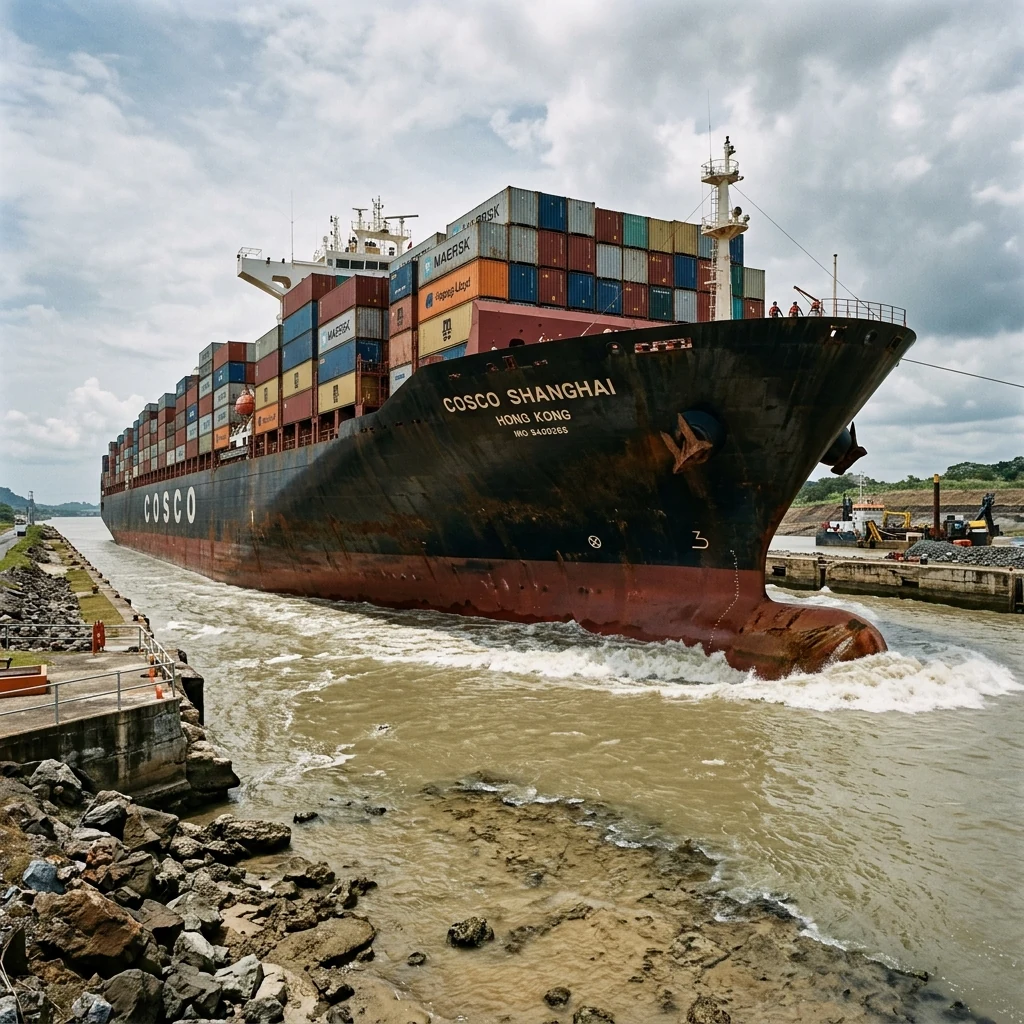
Sailing into shallow waters, ports, or canals changes how a vessel behaves. Squat and the available Under Keel Clearance (UKC) must therefore be assessed as part of the approved passage plan.
The Danger of the Squat Effect
Squat is the bodily sinkage and trim change that can occur as a moving ship alters the flow and pressure field around its hull in shallow or confined water. Its magnitude depends on the hull, loading condition, speed through the water, depth, channel geometry, blockage and environmental conditions.
Using an Empirical Squat Estimate
A common Barras-style empirical estimate uses the vessel's speed through the water (STW) and block coefficient (Cb). SOG is not interchangeable with STW when current is present.
Open-water squat estimate (m) ≈ (Cb × STW²) / 100 This is an empirical estimate, not a universal prediction. Confined-water effects must not be represented by an automatic fixed doubling; use an approved method that accounts for the applicable channel geometry and blockage.
Because the speed term is squared, a change in STW can materially change the estimate.
Building the UKC Assessment
A planning structure may subtract static draft, squat and other required allowances from the available charted depth plus tide:
Estimated dynamic UKC = (Charted depth + tide) - (corrected draft + squat + required allowances)
The allowances and acceptance limit must come from approved ship-specific information, company procedures, port or waterway requirements, and the passage plan. Include the applicable trim/list, density, wave and motion allowances and uncertainty. CaptainCalc is decision support only; verify every operational result with the approved sources for the vessel and transit.
Sources and verification
Use these references as the starting point for verification; always follow current flag-state, company, port, and approved shipboard documents for operational decisions.
Calculate Squat Instantly with CaptainCalc
Don't rely on paper charts and guesswork in confined waters. CaptainCalc features a built-in Squat & UKC calculator that deterministically applies your vessel's exact Block Coefficient and confined-water multipliers instantly, completely offline.