
Quick answer: what is GM in ship stability?
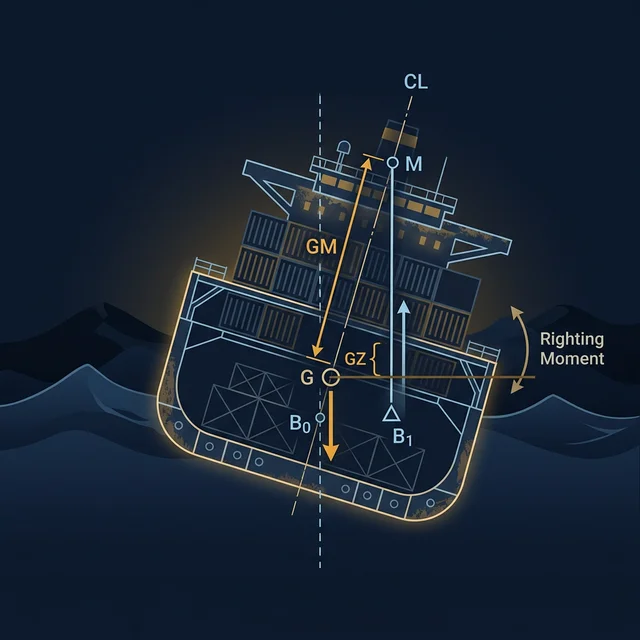
GM is metacentric height: the vertical distance between the ship's center of gravity (G) and metacenter (M). It is the first check for initial stability, but departure safety also requires GZ curve area, range of stability and free-surface corrections.
- Positive GM means G is below M and the vessel has an initial restoring moment.
- Low GM makes the ship tender; high GM makes it stiff and can create violent rolling.
- Negative GM is an emergency because the vessel can loll or capsize unless ballast, cargo or free-surface conditions are corrected.
This page explains the operational meaning of GM: why low, high or negative metacentric height changes roll behavior, loll risk and intact stability compliance. For formula-first worked examples, use the companion ship stability calculations guide.
A vessel's stability is its ability to return upright after wind, waves or cargo movement heel it over. GM is the first signal, but safe departure also depends on the full GZ curve, free surface correction and approved loading condition.
The Three Points of Initial Stability
Understanding GM requires visualizing three points on the ship's vertical centerline:
- K (Keel): The absolute bottom of the ship. This is the baseline from which all vertical measurements are taken.
- G (Center of Gravity): The theoretical point where all the weight of the ship and its cargo is concentrated. When you load heavy cargo high up, G moves up.
- M (Metacenter): Think of this as the pivot point the ship swings under. The position of M is determined by the underwater shape of the hull. As a ship rolls, the shape of the displaced water changes, meaning M can shift.
What is GM?
The distance between the Center of Gravity (G) and the Metacenter (M) is the GM.
GM = KM − KG
where KM is the height of the metacenter above the keel (obtained from hydrostatic tables at the current draft), and KG is the height of the center of gravity above the keel (calculated from the loading condition).
For a ship to be stable, G must be below M — a positive GM. If G rises above M due to loading too much weight high up, GM becomes negative and the ship will loll or capsize.
Step-by-Step GM Calculation Example
Consider a general cargo vessel with the following loading condition:
| Item | Mass (t) | KG (m) | Moment (t·m) |
|---|---|---|---|
| Lightship | 4,200 | 6.80 | 28,560 |
| Cargo Hold 1 | 1,800 | 4.20 | 7,560 |
| Cargo Hold 2 | 2,000 | 5.10 | 10,200 |
| Fuel Oil DB | 320 | 1.05 | 336 |
| Ballast Water | 500 | 0.80 | 400 |
| Total Displacement | 8,820 | — | 47,056 |
Step 1 — Calculate solid KG:
KG = Total Moments ÷ Total Displacement = 47,056 ÷ 8,820 = 5.335 m
Step 2 — Read KM from hydrostatic tables at displacement 8,820 t:
KM = 7.12 m (interpolated)
Step 3 — Calculate solid GM:
Solid GM = KM − KG = 7.12 − 5.335 = 1.785 m
Step 4 — Apply Free Surface Correction (FSC):
Fuel tank FSM = 280 t·m → FSC = 280 ÷ 8,820 = 0.032 m
Fluid GM = 1.785 − 0.032 = 1.753 m ✓ (well above IMO minimum)
What GM Values Are Acceptable?
The IMO Intact Stability (IS) Code 2008 (Resolution MSC.267(85)) sets the minimum required fluid GM at 0.15 m for most cargo vessels. However, GM alone is insufficient — the GZ curve must also meet area and range criteria (see below).
In practice, typical operating GM ranges vary by vessel type:
| Vessel Type | Typical GM Range | Notes |
|---|---|---|
| General Cargo | 0.50 – 1.50 m | Wide range depending on load distribution |
| Bulk Carrier | 0.50 – 3.00 m | High GM in ballast condition is common |
| Container Ship | 0.30 – 1.00 m | Lower GM preferred to reduce roll acceleration |
| Tanker (loaded) | 0.50 – 2.00 m | FSM from slack tanks is the critical variable |
| Ro-Ro / Ferry | 0.50 – 1.20 m | Damage stability governs; watertight integrity is critical |
The Danger of Free Surface Moments (FSM)
Liquids in partially filled tanks (slack tanks) represent a significant danger to stability. As the ship rolls, the liquid sloshes to the lower side, effectively shifting the Center of Gravity (G) off the centerline.
Mathematically, this sloshing effect is treated as a virtual rise in the Center of Gravity. The Free Surface Moment (FSM) is calculated from the tank's breadth and liquid density:
FSM = ρ · i
where i is the second moment of area of the liquid surface about the tank's centerline, and ρ is the liquid density. The Free Surface Correction applied to KG is:
FSC = Total FSM ÷ Displacement
Practical rule: avoid slack tanks where possible. A tank is either pressed full or completely empty. Each slack tank can reduce fluid GM by 0.02–0.20 m depending on its breadth.
Beyond GM: The GZ Curve (Righting Arm)
GM only describes the ship's initial stability at very small angles of heel (0 to about 10°). What happens when a rogue wave pushes the ship to 30° or beyond?
For large angles, we rely on the GZ Curve. The Righting Arm (GZ) is the horizontal distance between the upward force of buoyancy and the downward force of gravity at a given angle of heel.
The IMO IS Code 2008 requires all of the following:
- GZ ≥ 0.20 m at 30° heel
- Maximum GZ at an angle of heel ≥ 25°
- Area under GZ curve from 0–30° ≥ 0.055 m·rad
- Area under GZ curve from 0–40° (or to flooding angle) ≥ 0.090 m·rad
- Area under GZ curve from 30–40° ≥ 0.030 m·rad
A ship can have a perfectly positive GM yet still fail these GZ criteria — which is why checking the full stability booklet is mandatory before departure.
Stiffness vs Tenderness
Not all positive GM is desirable. A very high GM makes a ship stiff — it resists heeling aggressively and snaps back upright quickly. While this sounds safe, it creates rapid, violent rolling that can injure crew, shift cargo, and damage lashing equipment.
A very low GM (but still positive) makes a ship tender — it rolls slowly with a long period. This feels comfortable but leaves little margin against unexpected loads.
| Condition | Roll Period | Risk |
|---|---|---|
| Stiff (GM > 2.0 m) | Short (< 10 s) | Cargo shift, structural stress, crew injury |
| Acceptable (0.30–1.50 m) | Moderate | Optimum for most conditions |
| Tender (GM < 0.20 m) | Long (> 25 s) | Approaching loll; small extra load can cause capsize |
How to Correct Low or Negative GM
If the calculated fluid GM is below the required minimum, officers have several corrective options before departure:
- Add low ballast: Fill double-bottom tanks with sea water. This lowers G (reduces KG), directly increasing GM. This is the fastest and most effective fix.
- Discharge topside weight: Remove heavy cargo or equipment from upper decks, reducing KG.
- Press up slack tanks: Fill partially filled tanks to eliminate free surface moments and recover fluid GM.
- Redistribute cargo: Move cargo from upper holds or decks to lower holds.
- Reduce GM if too high: Pump out some double-bottom ballast, or distribute weight higher if the vessel is dangerously stiff and rolling violently.
Always recalculate the loading condition in the stability software (or approved loading computer) after any corrective action and verify all GZ criteria are met before sailing.
Frequently Asked Questions
Sources and verification
Use these references as the starting point for verification; always follow current flag-state, company, port, and approved shipboard documents for operational decisions.
Check GM and intact stability cases offline
The CaptainCalc Stability module lets you establish your Vessel Profile and instantly run multiple loading conditions. It computes precise GM, interpolates KM from your hydrostatic data, applies FSM corrections, and gives clear warnings if any IS Code criterion is breached. Works completely offline.